|
| Just a hedge. Nothing special. Not relevant to anything. |
We're creatures of habit, my wife and I. Both retired, living 35 years in a house way too big for just the two of us, and our interests in life are pretty well set. My wife knits constantly. She also plays soccer most weekends from September through May. We watch a lot of soccer on TV: US women's and men's national teams, and the English Premier League, August to June. (I'm a Liverpool fan, she's a Chelsea fan, but we both like watching most of the Premiership teams.) We have our routines for housework and maintenance, inside and out. We go out to dinner now and then. When it gets hot, like now, we just kind of slow down, though outside observers may not be able to tell the difference in life's pace. (The main difference in summertime is that we run a couple of window-unit air conditioners more often. Our house was built before AC was a thing, so we don't often need it. We've never had an electric bill above $120.)
So I don't know what's happened recently; it's like a flurry of activity by our standards ever since I got back from my little county-counting trip to Georgia. (That link, by the way, is to the first of six blog posts describing the trip. This blogger program seems to no longer notify people when I post something, so you may not have been aware that such a great piece of serial literature was even available for your perusal and edification. Not to be missed, though.) In the few days since then -- and in addition to the group stage of the Gold Cup, in which the US men's team found success while still disappointing fans, and our almost-weekly "date night," when we go out somewhere for dinner -- we actually did things for a change.
First, we went to the zoo. We live like a mile from the zoo and have not been there in, what, twenty-five years? It's a great zoo, one of the finest in the country, but it's like the Alamo, except we don't even suggest it to visitors from out of town. Mostly because we -- or I, at least -- consider it to be overpriced. I don't even know what they charge to get in, normally, but I know that at some point in the last two or three decades, I saw the figure and was shocked to the bottom of my Seventies-era soul.
But on June 15, they had what's called "Locals Day," and city residents could get in for $8 each. I know they've done that before, but I never heard about it until I saw the news report after the fact, so when I read about it somewhere I put it on my calendar, and we actually went!
There've been lots of changes at the zoo since the last time I was there, and after an hour or so it got pretty crowded, and then of course it got pretty hot. But it really is, still, a very good zoo. (And if you
do go, park under the freeway. It's a little less of a climb when you leave.) They've added a lot of open-area enclosures for the animals, and more are being built, and they've added some very interesting animals, including an okapi and a couple of Komodo dragons, and an entire exhibit area of Australian critters. Only the chupacabra exhibit just off Platform 9 3/4 was a disappointment; but then, they're nocturnal creatures and you can't expect to actually see them during the daytime.
And just a few days later, we went to a concert.
A concert! Us! Again, it was something of a surprise that we even knew about it before-hand, but we did, and we actually went! That so rarely happens. It was the final concert of the season by a local chamber-music quartet called Agarita. (I didn't even know they existed until I happened across a notice for this concert.) it was actually two concerts, one on Saturday at Incarnate Word, the other on Sunday at the Empire. I won't go to the Empire theater: there's insufficient room between the rows of seats for my knees, (and I'm not freakishly tall), so it had to be the performance at Incarnate Word. I looked on line for the program for the concert, fearing that it would be the kind of classical music that only musicians could love, but I could find nothing describing it, so I took a chance and got a pair of (free) tickets, figuring that we could sit at the very back, and if it started to sound like a traffic jam in Havana or Kampala, we could just leave.
There was, in all honesty, a point during the evening when I thought it was time to sneak out. Several such points, actually. The first came at the very beginning when a local poet named Naomi Shihab started reading some of her works, talking over the beginning of an excerpt from Aaron Copeland's Appalachian Spring in a weak, slightly strained-sounding voice and using a barely-functioning microphone (thank God they got that straightened out quickly!), as though that great piece of American orchestral music was written to accompany her poetry. Well.
Yet it worked. There actually seemed to be a conceptual connection between her poem and the musical imagery of Copeland's famous music. It did not distract, as I had feared it would. (I wish I could remember the poem. There were several excellent lines in her recital of poetry during the evening, when I was impressed by her turn of phrase, and I know at least twice I repeated lines to myself and swore I was going to remember them. I did not.) Likewise in the next piece, three selections from Ravel's Le tombeau de Couperin. The poetry was a yet more interesting part of the performance by comparison, because Ravel's music simply isn't as good as Copeland's. It's like the difference between a perfectly-cooked steak served on a fine china dish, versus the same steak served on a paper plate.
(I made a quick search while writing this, hoping to find one of the poems she read that evening; but there's simply too much to go through on the off chance of recognising a phrase only vaguely remembered. But I did come across this poem, which I really like; and if you like it, too, you can probably access more of her work easily from that page.)
In the middle part of the program there was another one of those moments that put me in mind of sneaking out, when the group (who were, by the way, joined for much of the program by a New York City-based woodwind ensemble called Imani Winds, but they sat out this particular segment of the concert) played two short pieces of Music I Could Do Without: Blue Dress by Julia Woolfe, arranged for string quartet, and sweet air by David Lang. But we stuck it out. Next up was a piece written by one of the members of the aforementioned Imani Woods, Mark Dover, and when he started off by explaining what had led him to write the piece (a sad story, of course, but I had left my empathy on the charger at home and was not moved), I remembered something I'd heard recently, to the effect that "If you have to explain it, it probably isn't very good to begin with." But the piece, called I Am, Here Now, surprised both of us as the most evocative work we heard during the entire concert. Not very long, maybe 4 or 5 minutes altogether, it painted a completely realized picture: I thought of a melancholy man alone at home, staring out the window into a rainy evening in a big, vibrant city, life seemingly passing him by. Extremely mellow, excellently arranged with just two instruments, piano and bass clarinet.... I can't remember when a piece of modern music has seemed so ... so vivid, so rewarding.
Well, the rest of the concert was anticlimactic. A pair of uninteresting but blessedly short compositions written specially for the Imani Woods group; a few more selections of Copeland; a Stevie Wonder song and a Donnie Hathaway song. None of those things reached the image-making level of I Am, Here Now.
There was, however, one other aspect of the evening that bears mentioning. In addition to the poetry and the music, the program included a performance of interpretive modern dance by someone named Tanesha Payne. I don't like modern dance. I think it's like abstract art -- capable of any meaning, and thus no meaning. When I saw her name on the program, I was nonplussed; when she actually came out to perform, to a piece by Reena Esmail called Saans, I was dreading it, and praying for a mercifully short performance. What actually happened, though, was something of a revelation.
 |
| taneshapayne.com/ |
Tanesha Payne, it turns out, is the embodiment of grace. Maybe there is particular meaning to this or that motion of the arms or legs, or the turning of the body in this direction or that; I don't know and I don't care. But within a very few moments of the start of her performance I was captivated by the sheer grace of her movements. It helps, no doubt, that she has perhaps the longest arms and legs of any human being alive today, but that can only add to the grace of her movements, it can't
be the graciousness itself. I don't know what this
Saans composition sounded like; I have no memory of it. Maybe it was good, more likely it was not. But whatever it sounded like, it was good enough to provoke one of the most elegant and compelling performances of modern dance that I, at least, have ever seen.
So. Wow. First the zoo, then this (unexpectedly) very enjoyable concert, where even the seats were comfortable. (I can't sit through a whole performance at the Majestic anymore, or even the new Tobin Center; and as I've already said, I can't even sit down in the Empire, let alone enjoy an entire show there. So the seats at Incarnate Word make a big, big difference.) This is practically unheard of in my existence here in San Antonio since retirement twenty years ago. It just doesn't happen, that we go out this often. But wait! There's more!
Because today I dragged the tarp off the convertible and we cruised up into the Hill Country to see an exhibition curated by the Smithsonian Institution called Crossroads: Change in Rural America. It's a travelling exhibition that I'd read about some time ago, and I was interested enough in the subject to put it on my calendar. If nothing else, it would be the excuse for a nice little road trip with the wife. Good weather, some winding roads, lunch in a small town (Bandera, where the exhibition was set up in the local middle school), and maybe we would learn a thing or two about something that has occupied a surprising amount of space in my brain for the last ten years or so. Because you can't avoid seeing that people in rural areas have become Red States, while people in urban areas have become Blue States. I didn't expect the Smithsonian to provide an explanation as to why this is so, but I was hoping for some small bit of enlightenment as to why rural America is different and how what must seem like rapid and incomprehensible change is driving the thinking of those people.
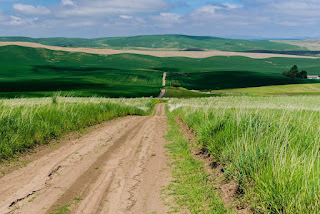 |
| (taken from the exhibition's page for its South Carolina incarnation) |
There was a little of that, a bit of implication as to how change affects the perception of American life in small communities. There is the implication that the (necessary) self-reliance of small communities seems threatened by the wholesale changes being forced on them as a consequence of the changes taking place in the cities, and by the clumsiness of government in failing to take the sensibilities of these small communities seriously when formulating policy. (The exhibition didn't say any of that outright, of course; it was too superficial an examination of the subject.)
And here's an opinion that will certainly be unpopular among my friends and family: I can see from this exhibition why those knee-jerk reactionaries and Neo-Nazis in the pro-Trump camp -- that is to say, most of them -- are so down on "DEI." It is a subject that has become tiresome. (I don't agree with that view, least of all when it's harped on by the Big Orange, who is undoubtedly the stupidest and most ignorant person ever to fall all the way upwards, but I can certainly understand it.)
We had a nice lunch at the O.S.T. Restaurant (excellent service, good prices, nice atmosphere, pretty good food if you like cheese, and who doesn't), then headed over to take in the exhibit. The Smithsonian's show is in the middle of the large "cafetorium," while exhibits of local interest are along the sides. I couldn't enjoy those, though, because I couldn't hear the soundtrack for the video, over the voice of a very loud woman explaining everything about Bandera to a couple of new residents just a few feet away, and she wasn't moving. Gave up and went for the main exhibit, and by the time I'd looked through all of that I'd been standing up long enough for my own satisfaction. I was resting my legs with the intention of having a Round Two, but before I was ready Sherry was done with the whole thing, so we left. I wasn't really that interested in Bandera history anyway. It was enough to learn about the origin of dude ranches, which happened in Bandera, and the "Stompede," the big celebration of Cowboy Culture they used to hold in town before it all got out of hand.
So! Three outings in the space of ten days. That just doesn't happen around here. Truly abnormal. Unlikely to happen again.

 Posts
Posts